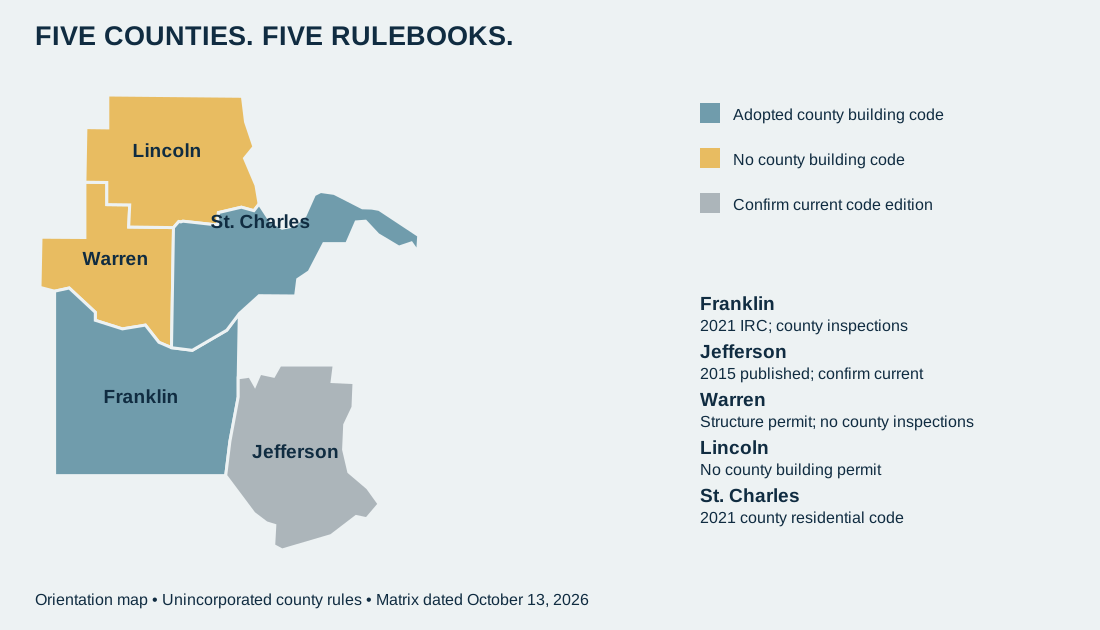
Missouri has no statewide residential building code, so whether your barndominium is inspected, what code it is held to, and what the permit costs are decided county by county — and in the St. Louis ring the answers run from a full 2021 code with inspections to no county permit at all. State law (RSMo 64.170) lets first- and second-class counties adopt building regulations; a county that had no code before August 2001 needs a vote of the affected area to adopt one; and a third-class county like Warren lacks the general power altogether, which a 2012 appeals court decision confirmed.
Compare county building codes and permit requirements
| Franklin | Jefferson | Warren | Lincoln | St. Charles | |
|---|---|---|---|---|---|
| County class | 1st | Charter | 3rd | 2nd | Charter |
| Building code | ✔ 2021 IRC/IBC/IMC/IPC/IFC, 2020 NEC — effective April 23, 2024 | ✔ 2015 IRC/IBC/IMC/IPC/IECC per published Code §500.010; confirm whether a newer edition has been adopted | ✔ None — no county building inspections, no certificate of occupancy | ✔ None — "no permits are required to be obtained from the County, including occupancy permits, building permits" | ✔ 2021 St. Charles County Residential Code (2021 IRC amended), §500.150 |
| Permit required for a dwelling | ✔ Yes — Building Dept, Union | ✔ Yes — Code Enforcement, Hillsboro | ✔ Yes — P&Z "Structure Permit" for every structure regardless of size or use | ✔ No county permit; floodplain permit if mapped | ✔ Yes — Building & Code Enforcement |
| Fees | ✔ $25 application; permit fee by square footage (schedule not published online); escrow $350 for 1–2 family ($500 if fee ≥ $1,500), refunded on passing final; $200 sewer escrow | ✔ Fee on actual construction cost with a valuation floor of $120/sq ft new residential (§500.250) | ✔ $150 single-family residence; $200 septic; $10 electric sticker; fees double if work starts first (schedule effective Feb 3, 2026) | ✔ None from the county | confirm |
| Permit term | ✔ 365 days | confirm | ✔ Septic permit 1 year | — | confirm |
| Inspections | ✔ County inspections through to the final | ✔ County | ✔ None by county; Sanitarian's septic final precedes the permanent electric sticker | ✔ None by county; fire districts handle electrical/occupancy | ✔ County |
| Fire district permits | — | — | ✔ Warrenton FPD and Wright City FPD require their own building permits in their areas | ✔ Lincoln County FPD, Winfield-Foley, Hawk Point, Eolia, Warrenton, Wright City FPDs handle occupancy/electrical | — |
| Design table (R301.2) | ✔ Snow 20 psf; wind 105 mph; SDC C; weathering Severe; frost 30 in; termite Moderate–Heavy; winter design 0°F | confirm | — (no code) | — (no code) | ✔ Snow 20; wind 107; SDC C; Severe; frost 30; termite Moderate–Heavy |
| Ag-building exemption | ✔ R105.2 amended: exempt only if it houses implements/hay/grain/poultry/livestock exclusively, sits ≥200 ft from any residence, with notarized certification + plot plan; a dwelling is never exempt | ✔ UDO: "agricultural buildings … but not including dwellings" | ✔ Zoning: "moveable agricultural structures" not structures; "development" excludes agricultural activities — a dwelling is not an agricultural activity | — | confirm |
| Zoning minimum lot | confirm (ag district) | ✔ RA-5: 5 acres, 1 dwelling / 5 acres; cluster 1 acre | ✔ AG: 3 acres, 1 dwelling / 3 acres; 50-ft setback from road right-of-way | ✔ No county zoning; Troy, Elsberry, Moscow Mills, Winfield have their own | ✔ A: 5 acres (3-acre tract around an existing residence); 800 sq ft minimum dwelling |
| Septic | ✔ County On-Site Sewage Ordinance adopted Sept 23, 2025, effective Oct 1, 2025; permit via Building Dept | confirm office | ✔ Sanitarian; soil scientist evaluation with pits; county-registered installer; permit before structure permit | ✔ Health Department | ✔ Private Sewage Disposal Code §500.300 via Building & Code Enforcement |
| Floodplain | ✔ Flood Damage Prevention Ordinance via P&Z; NFIP participant | ✔ NFIP participant | ✔ Flood ordinance + Floodplain Development Permit; all parcels checked | ✔ Floodplain Development Permit required | ✔ NFIP participant |
| Driveway | ✔ County Highways Entrance Permit; MoDOT on state routes | confirm | ✔ Road & Bridge on county roads; MoDOT on state routes | confirm | confirm |
| 911 address | ✔ P&Z is the addressing authority | confirm | ✔ Required before the permit | confirm | confirm |
| Other | ✔ Wood foundations prohibited (IBC 1807.1.4 amended) | ✔ Arnold (city) banned pole buildings and metal primary siding on 1–4 family dwellings, June 17, 2021 | ✔ No certificate of occupancy issued | ✔ City of Troy etc. have P&Z | ✔ Wentzville, O'Fallon, St. Peters, St. Charles city separate |
What each situation means for the build
Franklin County — the full-code case. Since April 2024 a barndominium here is a permitted, plan-reviewed, inspected house on the 2021 IRC. The county's amended code adds a few things worth knowing: wood foundations are not allowed; the escrow is refunded when the final passes; the design table requires a 30-inch frost depth and Seismic Design Category C, which drives the post-frame engineering. The agricultural exemption is written tightly and excludes dwellings by construction. Franklin County page.
Jefferson County — code with a question mark on the edition. The county's published code adopts the 2015 family; the county's website blocked our read of any later adoption, so the application will settle it. Fees are percentage-of-value with a $120-per-square-foot floor — a 2,000-square-foot home is valued at no less than $240,000 for the fee calculation. RA-5 zoning needs five acres. And Arnold, inside the county, prohibits metal-sided homes. Jefferson County page.
Warren County — permit but no code. Every structure needs a structure permit, the septic permit comes first, the 911 address comes before that, and if you start work before the permit the fee doubles. But nobody from the county inspects the building, and the county issues no certificate of occupancy. The Warrenton and Wright City fire protection districts fill part of that gap with their own permits in their areas. For a lender, "no CO" means the draw inspector is the inspector. Warren County page.
Lincoln County — nothing from the county. No zoning, no building permit, no occupancy permit for unincorporated land, by the county's own statement. Floodplain permits, Health Department septic permits and fire-district electrical/occupancy still apply, and the cities run their own zoning. It is also the fastest-growing county in the ring (+11.9%, 2020–2025), which makes it where a barndominium meets the least paperwork — and where buyers of resale barndominiums should ask the most questions. Lincoln County page.
St. Charles County — code plus zoning minimums. The county's own 2021 residential code, a five-acre A-district minimum, and an 800-square-foot minimum dwelling. The county's municipalities — Wentzville, O'Fallon, St. Peters, St. Charles, Lake St. Louis, Cottleville — each issue their own permits. St. Charles County page.
The things that apply everywhere
- Floodplain. All five counties participate in the National Flood Insurance Program and require a floodplain development permit for any construction in a mapped special flood hazard area, including the "no-code" counties.
- Septic. Missouri's state permit rule excludes single-family lots of three acres or more (RSMo 701.031), but every ring county with an ordinance regulates every lot. A soil evaluation by a qualified soil scientist with a profile pit is the norm. See land, septic and well.
- Wells. Drilled by a Missouri-permitted well installation contractor (RSMo 256.603); the owner-drills-own-well exception is real but not practical.
- State highway access. A driveway onto a MoDOT route needs a permit to work in the right-of-way; stopping sight distance must be met or the permit is denied.
- Electric. Ameren's tariff gives an individual residential customer single-phase overhead service with up to 1,000 feet of line (500 on private property) at no cost; beyond that you pay in advance. Co-op policies (Cuivre River, Crawford, Three Rivers) are not published online — ask.
Frequently asked questions
If Lincoln County has no permits, can I build whatever I want? On unincorporated land outside a floodplain, the county will not stop you. The fire district, the Health Department (septic), your lender, your insurer and the next buyer will all have opinions. Build it to the IRC anyway; it costs little more and it is what the appraiser and underwriter expect.
Does Warren County inspect anything? The Sanitarian inspects the septic system. Nothing else at the county level; fire districts in Warrenton and Wright City inspect within their boundaries.
Can I get the Franklin County escrow back? Yes — it is refunded when the final inspection passes.
Which counties have a minimum house size? St. Charles County (800 sq ft in the A district). Jefferson's and Franklin's minimums we could not verify; Warren and Lincoln have none that we found.
I'm building inside Union / Washington / Troy / Wentzville. Does this table apply? No. Each city has its own code and permit office. Ask the city.
Next step
Custom barndominiums carries the permit work in every county. Related: the complete guide · land, septic and well · HOA, covenants and city bans · all counties.